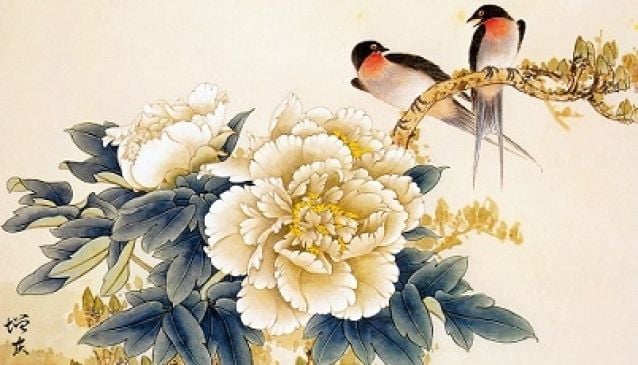
Art of Chinese Painting
According to their means of expression, Chinese paintings can be divided into two categories.
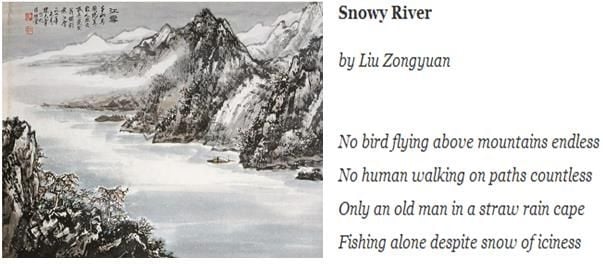
According to their means of expression, Chinese paintings can be divided into two categories: Xieyi School is marked by exaggerated forms and freehand brush work and Gongbi School is characterized by close attention to detail and fine brush work.Xieyi, however, is the fundamental approach to Chinese painting. It constitutes an aesthetic theory, which above all, emphasizes the sentiments. Gu Kaizhi, a famous artist of the Jin Dynasty (c. 345-406), was the first to put forward the theory of "making the form show the spirit". In his opinion, a painting should serve as a means to convey not only the appearance of an object, but to also express how the artist looks at that object.
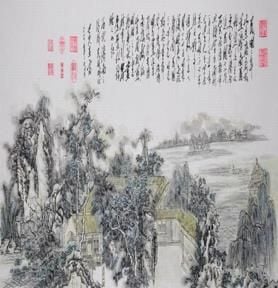
Different from Western paintings, a Chinese painting is not restricted by the focal point in its perspective. The artist may paint all the scenes along the Yangtse River on a piece of paper or silk that is long and narrow. It can be said that the adoption of shifting perspective is one of the characteristics of Chinese painting. Why do the Chinese artists emphasize the shifting perspective? They want to break away from the restrictions of time and space in order to include, in their pictures, things that are both near and far. Also, the artists find that in life, people view their surroundings from a mobile focal point. As one walks along a river or in a garden, one sees everything on the way. The shifting perspective enables the artist to express freely what he wants.
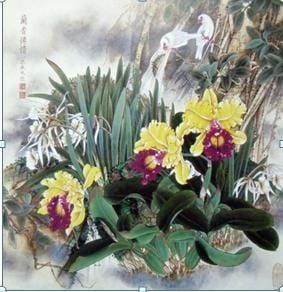
Chinese calligraphy and Chinese painting are closely related because lines are used in both. Chinese people have turned simple lines into a highly-developed form of art. Lines are used not only to draw contours but also to express the artist's concepts and feelings. A variety of lines are used for different subjects and different purposes. They may be straight or curved, hard or soft, thick or thin, pale or dark, and the ink may be dry or running. The use of lines and strokes is one of the elements that give Chinese painting its unique qualities.